
Travel My Kashmir · 41 Kashmir–Ladakh tours led personally by our trip designer Imran since 2018 · acclimatisation plan included · permits filed for you · +91 9796466052
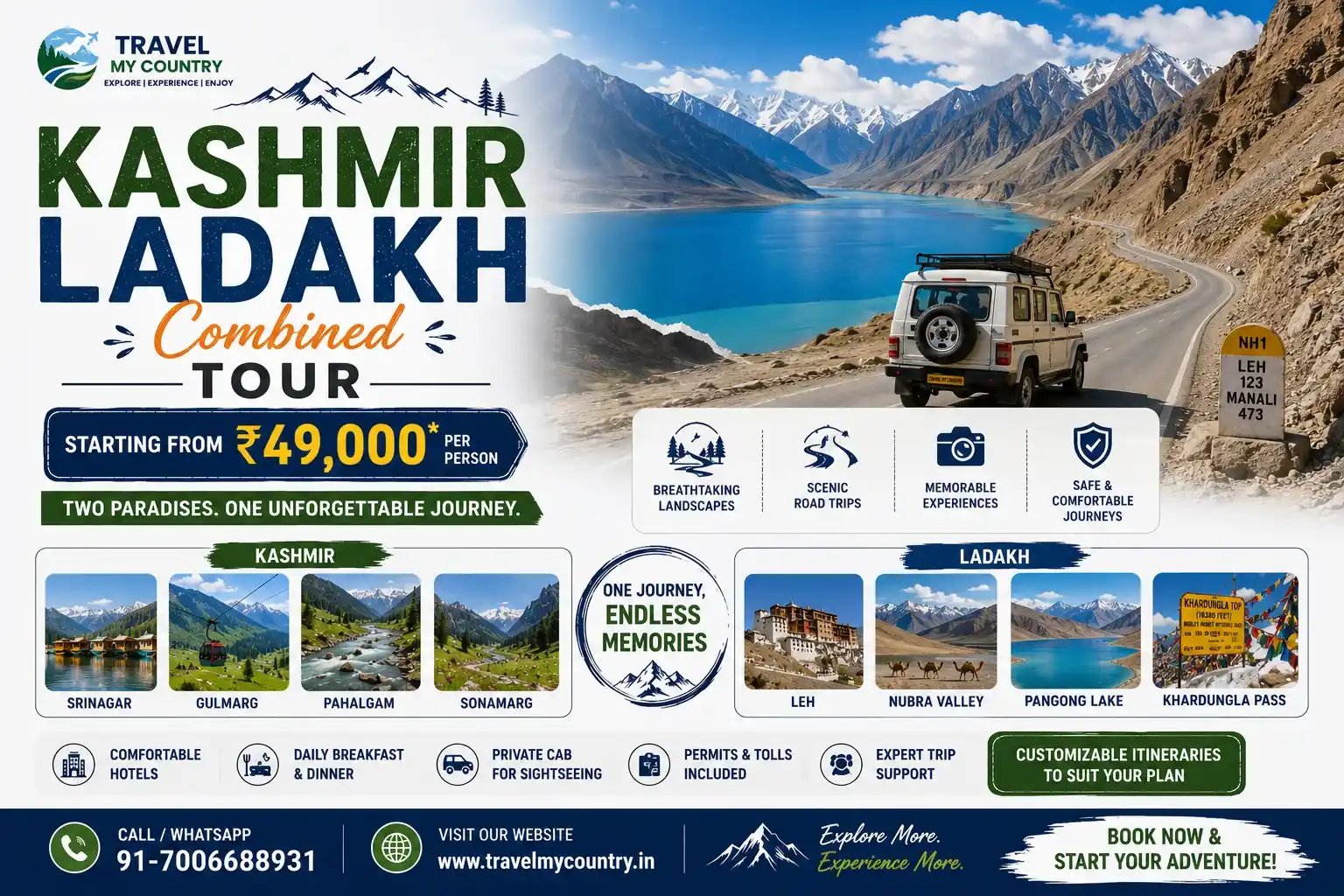
If you have ten days, this is the trip to do. You start with Day 1 on a Dal Lake houseboat at 1,585 m. By Day 8 the wind whips across Khardung La at 18,380 ft. In between you cross five climate zones, three altitude belts, and arguably the most diverse stretch of landscape in India. Our trip designer Imran has personally led 41 of these tours since 2018; the itinerary below is his current preferred version.
The moment that defines this trip is somewhere on the Srinagar–Leh highway between Drass and Kargil, usually late afternoon on Day 5. The walnut orchards are gone. The rice paddies are gone. The road is now running alongside bare granite ridgelines and the Suru River, and you understand — physically, not just intellectually — that you’ve crossed into a different world. That transition is what makes the combined tour worth doing rather than flying directly into Leh. You earn the altitude and the landscape reveals itself in stages.
The Case for Combining Kashmir and Ladakh in One Trip
- Avoids the AMS shock of flying directly into Leh (3,500 m) — you acclimatise gradually: Srinagar (1,585 m) → Drass (3,200 m) → Leh (3,500 m) → Pangong (4,250 m)
- Two airports = flexibility: fly into SXR, fly out of IXL (Leh). No doubling back.
- The most scenic drive in India — Srinagar to Leh via Zojila and Kargil — is built into Days 5–7
- Single operator handles cars, permits, and hotels in both regions. No handoff confusion.
- Covers both Sufi Kashmir and Tibetan Buddhist Ladakh — two complete cultural worlds in one itinerary
Day-by-Day 10D/9N Itinerary
Days 1–4: Kashmir
Day 1 — SXR airport pickup and transfer to your Dal Lake houseboat. Sunset shikara ride covers the Nagin channel and comes back along the Boulevard with the Zabarwan hills turning amber. Dal Lake at dusk from water level is a specific experience that doesn’t translate to photographs; it requires being there.
Day 2 — Mughal Gardens in sequence (Shalimar Bagh, Nishat Bagh, Chashme Shahi), then Tulip Garden if visiting in late March–April. Drive to Gulmarg and check into your hotel at the meadow base — you’ll want the evening light on the Pir Panjal range from Gulmarg itself.
Day 3 — Full Gulmarg day. Gondola Phase I to Kongdoori (2,600 m) and Phase II to Apharwat summit (4,200 m). From Apharwat on a clear day you can see 80 km of Himalayan ridgeline including Nanga Parbat. Return to Srinagar or stay overnight in Gulmarg depending on your pace preference.
Day 4 — Drive to Pahalgam via the Pampore saffron fields (October visitors see the purple flowers; spring visitors see the dried-stub fields that still carry the smell). Aru Valley (quiet, trailhead for Tarsar Marsar trek) and Betaab Valley (wide Lidder bowl, Bollywood-famous) are both doable in an afternoon from Pahalgam town.
Days 5–6: Cross to Ladakh via Zojila, Drass, and Kargil
Day 5 — The longest drive of the trip: Pahalgam to Sonamarg (3.5 hours), then Zojila Pass (11,575 ft — the gateway from Kashmir to Ladakh), then Drass town with a stop at the Kargil War Memorial (25 km from Drass, built at the base of Tololing). Night in Drass. Temperature drops sharply; carry a fleece even in July.
Day 6 — Drass to Lamayuru: this 150-km stretch passes through Kargil (Shia Muslim majority town, the cultural heart of the Suru Valley), Mulbekh village with its 9th-century rock-carved Maitreya Buddha, and the Indus-Zanskar confluence at Nimmu. Lamayuru Monastery sits above a landscape that looks like the surface of the moon — “moonland” is the local descriptor and it’s accurate. Night in Lamayuru.
Days 7–9: Ladakh Circuit
Day 7 — Lamayuru to Leh via Magnetic Hill (where optical illusion makes cars appear to roll uphill), the Indus-Zanskar confluence (two rivers of completely different colours joining), and the Hall of Fame war museum at Leh. Afternoon rest in Leh — this is the acclimatisation day, and it’s non-negotiable. No major exertion above the Main Bazaar level.
Day 8 — Leh to Nubra Valley via Khardung La (18,380 ft — highest motorable road in the world on a maintained tarmac surface). The descent into Nubra is one of the most dramatic in Ladakh: from frozen moonscape to sand dunes in 35 km. Diskit monastery overlooks the valley; Hunder has double-humped Bactrian camels against a sand-dune backdrop. Night in Hunder or Diskit.
Day 9 — Nubra to Pangong Tso via the Shyok road (an alternative to returning via Khardung La — scenic river valley drive). Pangong at 4,250 m sits at the India-China LAC; the lake changes colour through the day from blue to turquoise to steel. Overnight at a Pangong camp or return to Leh (5 hours).
Day 10: Fly Out from Leh (IXL)
Early morning Leh airport drop. Most flights depart 6 AM–10 AM — afternoon flights are frequently cancelled due to Leh’s thermal winds. Delhi: 70 minutes. Mumbai: 2 hours 30 minutes. Book morning flights and add a day buffer for weather-related cancellations in monsoon season (July–August).
Cost per Person 2026
| Group size | Standard 10D/9N | Premium 10D/9N |
|---|---|---|
| 2 pax | ₹62,500 | ₹98,000 |
| 4 pax | ₹52,000 | ₹85,000 |
| 6 pax | ₹49,000 | ₹78,000 |
Standard includes Innova Crysta, 3-star hotels throughout, and a deluxe Dal Lake houseboat. Premium upgrades to a Fortuner 4×4, 4/5-star hotels, a Heritage houseboat on the Dal, and a private camp at Pangong. Both tiers include all transport, driver accommodation, permits, and ILP filing — no hidden charges at checkpoints or on the road.
Vehicle Plan — Two Drivers, One Seamless Transfer
We use a Kashmiri driver and an Innova Crysta from Srinagar to Leh (Days 1–7). At Leh airport we hand over to a Ladakhi driver — a J&K Tourism rule requires local operators for the Nubra-Pangong circuit (Days 8–10). The switch is pre-arranged, happens in 10 minutes, and both drivers have our dispatch line on speed dial. Switching cars is the law, not our preference; it works seamlessly in practice.
AMS Prevention Plan
- Start Diamox 125 mg twice daily 24 hours before Zojila crossing (Day 5); consult your doctor before the trip
- Hydrate aggressively — 4 litres/day from Day 5 onward
- Avoid alcohol completely until Day 8 (post-Leh acclimatisation)
- Day 7 is a mandatory rest day in Leh; exertion limited to the Main Bazaar walk (3,500 m)
- Carry portable oxygen — ₹2,500 cylinder rental available from us
- If persistent headache, nausea, or confusion at Khardung La: descend immediately, don’t wait it out
Permits, Aadhaar, and Checkpoint Protocol
- Inner Line Permit (ILP) for Nubra and Pangong — we file 5 days ahead with Aadhaar + 2 photos at no extra charge
- Foreigners need a Protected Area Permit (PAP) — 7-day lead time, ₹400 fee, we file on your behalf
- Carry original Aadhaar/passport for all checkpoints: Sonamarg, Zojila, Drass, Kargil, Khaltse, Khardung La, Shyok, Tangtse, Spangmik
- Postpaid SIM essential — BSNL or Airtel. Jio works inconsistently in Kargil and Nubra. No signal at Pangong.
Shorter and Longer Options
- 7D/6N Express — Kashmir 2 nights + Ladakh 4 nights. ₹39,000 per person (4-pax group). Skip Pahalgam; compress Kashmir to Srinagar + Gulmarg only.
- 12D/11N Hanle and Tso Moriri Extension — Add Hanle (Indian Astronomical Observatory, 4,500 m) and Tso Moriri lake (4,522 m, strictly protected, fewer tourists than Pangong). ₹78,000 per person.
Frequently Asked Questions
Can a family with kids do this 10-day tour?
Yes, with caveats. Kids 10+ handle Ladakh well. Below 8, the Nubra and Pangong altitude can cause altitude sickness. We offer a “Kashmir + Leh-only” variant (skip Nubra and Pangong) that works well for younger children — still includes Khardung La as a viewpoint without the overnight at altitude.
How do we handle altitude sickness?
Pre-trip Diamox, gradual ascent built into the route, Day 7 mandatory rest in Leh, portable oxygen on Days 8–9. Across 41 tours we’ve had one evacuation — that guest had a pre-existing pulmonary condition they didn’t disclose at booking. Declare any cardiac, respiratory, or blood pressure conditions before we finalise the itinerary.
Is the SUV the same throughout?
No — Kashmiri driver and car from Srinagar to Leh (Days 1–7), then a Ladakhi driver and car for Nubra/Pangong (Days 8–10). This is a J&K Tourism rule, not our choice. The transfer at Leh is smooth and pre-arranged.
Can we fly into Srinagar and fly out of Leh?
Yes — that’s the recommended pattern. SXR has more daily flights from more cities; IXL (Leh) has fewer routes but IndiGo and Air India both operate Leh–Delhi–Mumbai. Book morning flights out of Leh.
What is the minimum age recommended?
10 years for the full circuit. Below 10, we recommend the Kashmir + Leh-only variant. Pregnant women in second/third trimester should not attempt the Pangong leg (4,250 m). Anyone over 65 with any cardiac history should consult a doctor before the Nubra and Pangong section.
When is the best time to do this tour?
June to September is the ideal window. June: snow still on the high passes, dramatic landscapes, fewer tourists. July–August: peak season, all routes open, warmest temperatures at Pangong. September: fewer tourists, clear skies, autumn colour beginning in Kashmir. Avoid October for the Ladakh section — Zojila and Khardung La can close with the first snowfall at short notice.
Plan Your Kashmir + Ladakh Trip
WhatsApp +91 9796466052 with your travel dates, group size, and departure city. We send the day-by-day plan, hotel options at both ends, and a permit timeline within an hour.
See also: Srinagar to Leh standalone · Kashmir packages · Fortuner cab · Honeymoon package · Best time to visit