
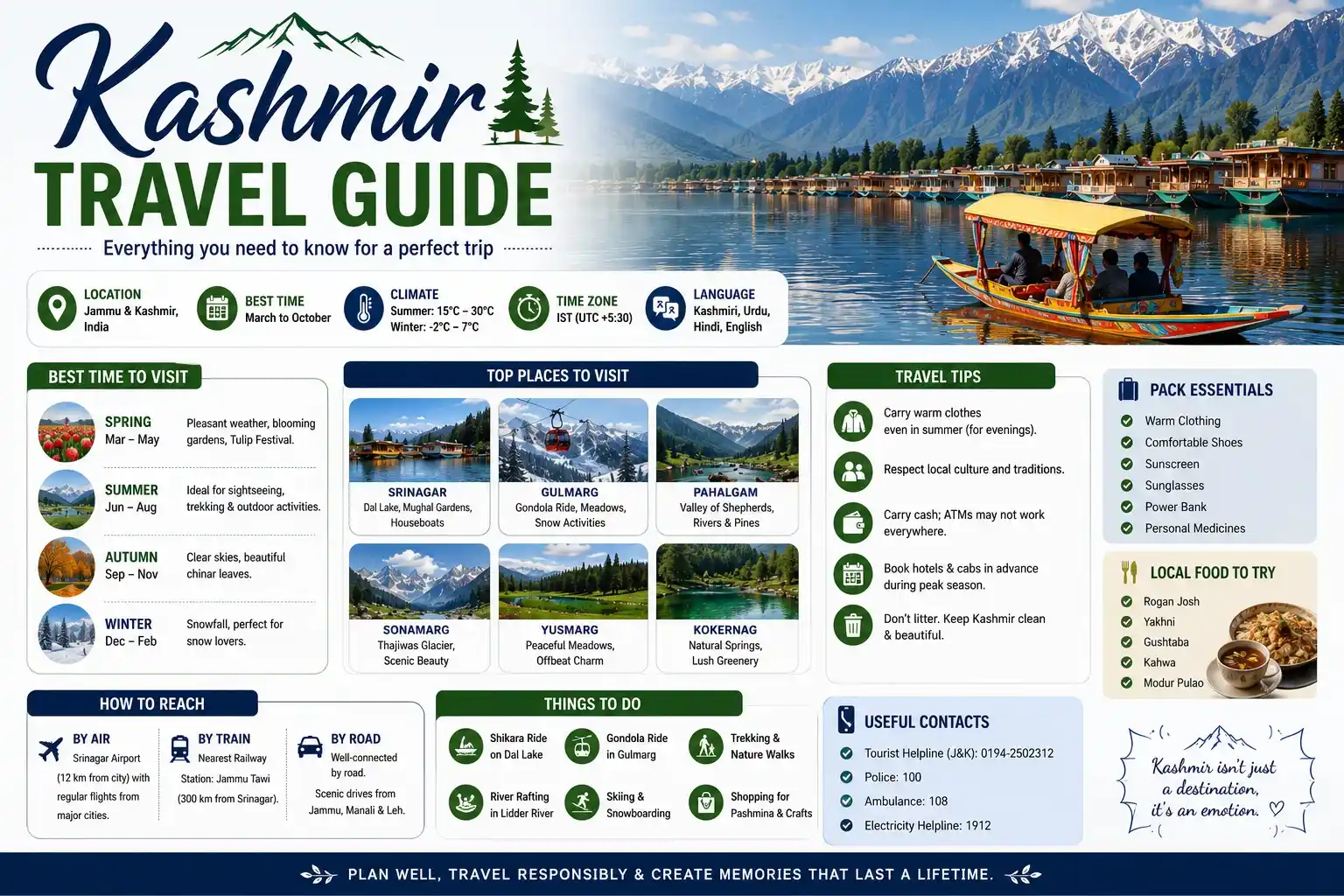
Kashmir is not a destination you visit once and forget. Travellers who come here for a week often find themselves researching their next trip before they have even landed back home. The valley has a quality that is difficult to describe without sounding hyperbolic — vast mountain ranges dropping into meadows, ancient gardens laid out beside mirror-still lakes, a culture of hospitality that is both genuine and unhurried. This Kashmir travel guide covers everything you need to plan your trip with confidence: the best time to visit, how to get here, where to go, what to eat, what it costs, and what to pack.
Where is Kashmir and How Do You Get There?
Kashmir refers to the Kashmir Valley — a broad, mountain-ringed basin in the Jammu & Kashmir Union Territory of northern India. The valley floor sits at around 1,600 metres above sea level, surrounded by the Pir Panjal range to the south and the Great Himalayan range to the north. Srinagar is the region’s main city and the summer capital of J&K.
By Air
The primary entry point is Sheikh ul-Alam International Airport (SXR) in Srinagar, which has direct flights from Delhi, Mumbai, Bangalore, Hyderabad, Chennai, Kolkata, Chandigarh, and several other Indian cities. Flight time from Delhi is approximately 1 hour 20 minutes. During peak season (May–June, December–January) fares rise sharply — book 4–6 weeks in advance if possible. We offer pre-booked Srinagar airport taxi service with flight tracking so your driver is waiting even if your flight is delayed.
By Road
Srinagar is connected to the rest of India via the Jammu–Srinagar National Highway (NH44). The drive from Jammu to Srinagar takes 6–8 hours (270 km) and passes through the Banihal tunnel and Jawahar Tunnel. Road conditions are generally good on this route but can be affected by landslides and weather. The highway is sometimes closed for a few hours for clearing — always check current road status before setting out. We can arrange a Kashmir cab service for the full overland journey if you prefer road travel.
Best Time to Visit Kashmir
Kashmir offers a different, compelling experience in every season. There is genuinely no bad time to visit — only different reasons to come.
- December to February (Winter): The valley is under snow. Gulmarg becomes one of Asia’s premier ski destinations. Srinagar is cold but magical — the houseboats on a frozen-edged Dal Lake, the snow-covered Mughal gardens, the silence of the city in January are unlike anything else. Best for: skiing, snow photography, experiencing Kashmir without the summer crowds.
- March to April (Spring): Temperatures rise from sub-zero to pleasantly cool. Almond blossoms appear in February, cherry blossoms in March. The tulip gardens of Indira Gandhi Memorial Tulip Garden (Asia’s largest tulip garden) open in late March or early April. This is one of the most beautiful periods in the valley — and the crowds have not yet arrived. Best for: gardens, blossoms, photography, mild trekking.
- May to June (Peak Summer): The most popular time. Schools are on holiday, and Gulmarg, Pahalgam, and Sonmarg are all fully accessible. The Gondola still has snow at Phase 2 in June. Prices are highest and Gondola tickets sell out 7–10 days in advance. Book everything early. Best for: first-time visitors, families, accessing all destinations.
- July to August (Monsoon): Kashmir is on the leeward side of the Himalaya and receives only the tail end of the Indian monsoon — far less rain than the rest of the country. The valley stays lush and green, temperatures are comfortable (20–25°C), and tourist numbers drop significantly. An underrated time to visit. Best for: budget travellers, those who prefer quieter experiences, lush green landscapes.
- September to November (Autumn): Our personal favourite. The chinar trees turn extraordinary shades of gold and red from late September. The apple and saffron harvests are in full swing. The air is crystal clear, the light is golden, and the tourist crowds of summer have thinned. Best for: photography, autumn foliage, cultural experiences, comfortable temperatures.
Top Destinations in Kashmir
Kashmir’s main destinations each offer a completely distinct experience. Most standard 5–7 day itineraries cover three of these; longer trips can add more.
- Srinagar — The summer capital. Dal Lake, Mughal gardens, houseboats, the old city bazaars. Allow 2–3 days minimum.
- Gulmarg — Adventure hub at 2,650m. The Gondola ride, skiing in winter, wildflower meadows in summer. 1–2 days.
- Pahalgam — The Lidder River valley. Baisaran meadow, Aru Valley, Betaab Valley, base for Amarnath Yatra. 1–2 days.
- Sonmarg — “Meadow of Gold.” Thajiwas Glacier, alpine trekking, the Srinagar–Leh highway. Best May–October. 1 day or overnight.
- Doodhpathri — Uncrowded high-altitude meadow, 42 km from Srinagar. The hidden gem for those who want peace over popularity. Day trip.
- Gurez Valley — Remote Dardic valley near the LoC. Exceptional trekking, zero commercialisation. Permit required; seasonal access May–November.
Where to Stay in Kashmir
Accommodation in Kashmir ranges from heritage houseboats on Dal Lake to 5-star mountain resorts to budget guesthouses in the old city. Here is a quick guide by type:
- Houseboats (Srinagar): The most iconic Kashmir accommodation. Handmade wooden boats moored on Dal or Nagin Lake, fitted with carved cedar interiors, dining rooms, and sun decks. Heritage houseboats are more expensive but genuinely special. Our Kashmir honeymoon package includes premium heritage houseboat stays.
- Luxury hotels: Srinagar has several internationally-standard properties including Vivanta by Taj Dal View, The Lalit Grand Palace, and Khyber Himalayan Resort in Gulmarg. Our Kashmir luxury package covers these options.
- Budget guesthouses: Srinagar, Pahalgam, and Gulmarg all have a wide range of clean, affordable guesthouses at ₹800–2,500/night. Our Kashmir budget package uses the best-value options in each location.
- Camping: For trekking routes like the Great Lakes of Kashmir and Tarsar Marsar, camping is the only option — and it is excellent. High-altitude campsites in Kashmir are among the most spectacular in India.
What to Eat in Kashmir
Kashmiri cuisine is one of the great undiscovered food traditions of India — rich, aromatic, slow-cooked, and entirely distinct from the rest of the country. The centrepiece of Kashmiri cooking is the Wazwan — a traditional multi-course feast of 30+ dishes cooked by a master chef (the Waza), typically served at weddings and special occasions but available at select restaurants in Srinagar.
Essential things to eat and drink in Kashmir: Rogan Josh (slow-braised lamb in Kashmiri spices), Yakhni (yoghurt-based lamb curry, subtler and lighter than Rogan Josh), Dum Aloo (baby potatoes in a deep spice paste — a revelation), Modur Pulav (sweet rice with dry fruits, typically served at the end of a Wazwan), Kahwa (green tea with saffron, cardamom, almonds, and rose petals — drink it every morning), Nun Chai / Sheer Chai (pink salty tea made with special leaves — an acquired taste but worth trying), and Shufta (a sweet dish of paneer and dry fruits).
Kashmir Travel Budget — What Does It Cost?
Kashmir suits every budget — from ₹1,500/day to ₹15,000+/day depending on accommodation, transport, and activities. Here is a realistic breakdown for a 6-day trip per person (assuming two people sharing):
- Budget trip (₹13,500–18,000 total): Budget guesthouses, shared cabs, local dhabas. Gondola Phase 1 only. Covers Srinagar, Gulmarg, Pahalgam. See our Kashmir budget package.
- Mid-range trip (₹25,000–35,000 total): Standard houseboat (1 night), 3-star hotels, private cab, Gondola both phases. Comfortable and covers all the highlights.
- Luxury trip (₹85,000+ total): Heritage houseboat, 5-star resorts, Fortuner or Crysta throughout, all activities. See our Kashmir luxury package.
Flight costs (Delhi–Srinagar return) typically range from ₹5,000–15,000 per person depending on how far in advance you book and the season.
Kashmir Packing List
What you need varies significantly by season — but some items are universal:
- Year-round: Layers (temperatures can drop 15°C+ after sunset even in summer), sunscreen SPF 50+ (UV is intense at altitude), sunglasses, a power bank, a light rain jacket, comfortable walking shoes.
- Winter additions (Dec–Feb): Thermal base layers, heavy down jacket, waterproof boots, woollen gloves, balaclava, hand warmers. Do not underestimate the cold, particularly in Gulmarg.
- For trekking: Trekking boots (broken-in before the trip), trekking poles, a down sleeping bag (for camping routes), a daypack, and blister prevention. Our guides provide camping and cooking equipment on all our organised Kashmir trekking packages.
- Documents: A valid government photo ID is mandatory for the Gondola, some hotel check-ins, and checkpoints on certain routes. Carry the original, not just a photocopy.
Cultural Tips for Visiting Kashmir
Kashmir is a predominantly Muslim region with deep-rooted traditions. A few things will make your visit more respectful and enjoyable:
- Dress modestly, particularly in the old city, mosques, and shrines. Shoulders and knees should be covered. Women should carry a scarf.
- Remove shoes before entering mosques, shrines, and many traditional homes.
- During Ramadan (dates shift annually), be respectful about eating and drinking in public during daylight hours.
- Ask before photographing people, particularly women. A simple gesture of asking is almost always met with a smile and permission.
- Bargaining is normal in the bazaars — but do it good-humouredly, not aggressively. The artisans making Pashmina, papier mâché, and walnut woodwork are selling their actual livelihood.
Frequently Asked Questions — Kashmir Travel Guide
Is Kashmir safe to visit in 2026?
Yes. Kashmir has seen record tourist footfall in recent years. All the destinations described in this guide — Srinagar, Gulmarg, Pahalgam, Sonmarg, Doodhpathri, Gurez — are open and welcoming to civilian tourists. We recommend booking through a registered local operator who can give you real-time information about road conditions and any local developments on your specific travel dates.
Do I need a permit to visit Kashmir?
Indian citizens do not need a permit for most of Kashmir, including all the standard tourist destinations. Some restricted border areas (like parts of Gurez and certain areas near the LoC) require a Protected Area Permit (PAP). Foreign nationals should check current permit requirements with the district administration or their operator before travelling to remote areas.
What is the best month to visit Kashmir for the first time?
For a first-time visit, May or early June is the most reliable choice — all destinations are accessible, the weather is pleasant, and the landscapes are at their most vibrant. If you want to avoid peak crowds and costs, September–October (autumn) is arguably the most beautiful time of year and much less busy than summer.
How many days should I plan for a Kashmir trip?
A minimum of 5 nights / 6 days is needed to cover Srinagar, Gulmarg, and Pahalgam at a comfortable pace. To include Sonmarg or a day trip to Doodhpathri, plan for 7–8 nights. For trekking itineraries (Great Lakes, Tarsar Marsar, Kolahoi Glacier), add the trek duration on top of any sightseeing days.
Can I visit Kashmir in winter?
Yes, and it is spectacular. December to February is the best time for skiing in Gulmarg. Srinagar is cold (temperatures can drop to -5°C) but magical in the snow. Some high-altitude routes and passes are closed, but the main destinations — Srinagar, Gulmarg, Pahalgam — are all accessible year-round. Pack very warm clothing.
Plan Your Kashmir Trip with a Local Team
Everything in this guide is drawn from our own experience running Kashmir tours since 2016. We are a Srinagar-based operator — not a Delhi travel agency selling Kashmir packages. Our guides live here, our drivers know these roads in every season, and our team answers the phone when you call.
Whether you want a Kashmir honeymoon package, a Kashmir family tour, an adventure-focused trip, or a fully custom itinerary built around your interests and budget — get in touch and we will sort it out.
WhatsApp: +91 700 66 88 931
Available seven days a week. We typically reply within a few hours.