
Staying on a houseboat on Dal Lake is the single experience most visitors to Kashmir remember for the rest of their lives. It is also the single experience most easily ruined by booking the wrong boat, in the wrong location, through the wrong channel. We have placed over 800 guests in houseboats since 2016. This is what we have learned.
What Is a Dal Lake Houseboat?
Kashmiri houseboats are cedar-wood structures built on floating pontoons — most were originally constructed in the early 20th century for British officers who were not permitted to own land in Kashmir. The craftsmanship is extraordinary: hand-carved walnut ceilings, papier-mâché panels, Persian carpet floors, and teak-panelled dining rooms. They do not move. They sit anchored on the lake, connected to the bank by a small wooden bridge. You sleep over water, hear kingfishers in the morning, and watch the mountains reflect on the surface at dusk.
Dal Lake vs Nagin Lake: Where to Stay
Dal Lake is larger, more famous, and more congested — especially the Boulevard Road stretch near the main market. Nagin Lake, connected to Dal by a narrow channel, is quieter, cleaner, and surrounded by willows and chinars rather than tourist stalls. For first-time visitors who want the iconic experience, Dal Lake is right. For anyone who has been before, or who prioritises peace over proximity to the market, Nagin Lake is the better choice. We can place guests on either — ask us when you book.
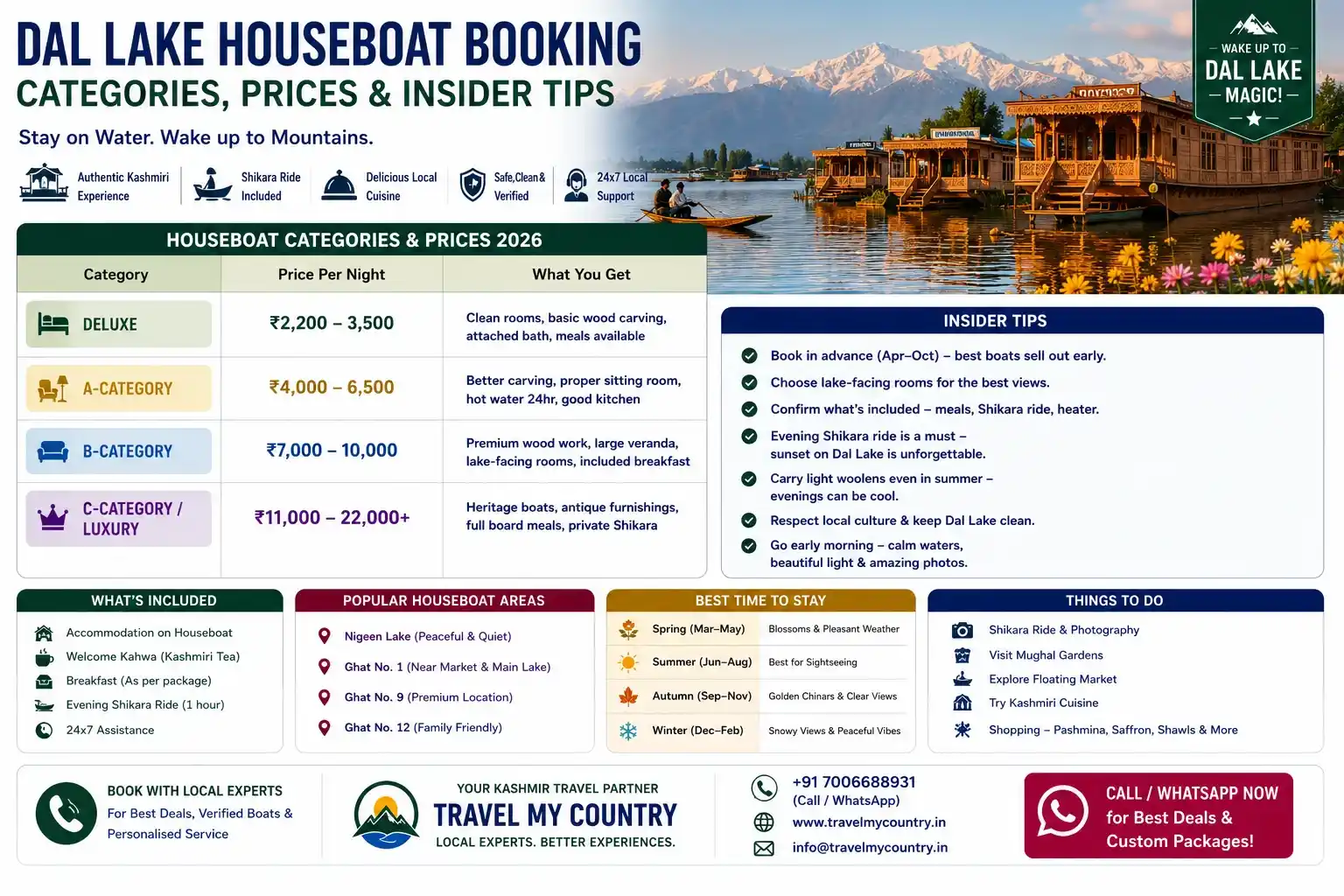
Houseboat Categories & Prices 2026
| Category | Price Per Night | What You Get |
|---|---|---|
| Deluxe | ₹2,200–3,500 | Clean rooms, basic wood carving, attached bath, meals available |
| A-Category | ₹4,000–6,500 | Better carving, proper sitting room, hot water 24hr, good kitchen |
| B-Category | ₹7,000–10,000 | Premium wood work, large veranda, lake-facing rooms, included breakfast |
| C-Category / Luxury | ₹11,000–22,000+ | Heritage boats, antique furnishings, full board meals, private Shikara |
Peak season pricing (April–June, September–October) runs 20–30% above these figures. Shoulder months (November, March) offer the best value with fewer guests on the lake.
What to Check Before Booking a Houseboat
This is where independent bookings most often go wrong. Before confirming any houseboat, ask for: (1) the J&K Tourism JKTDC registration certificate — all legitimate houseboats must display this and should share the number on request; (2) the exact GPS location on Dal or Nagin Lake — “Dal Lake” is vague, the difference between a quiet corner and a noisy main channel is 200 metres; (3) whether meals are included or extra — the best Kashmiri cooking happens in the houseboat kitchen, not in a restaurant; (4) the age of the boat — older heritage boats have character but sometimes have maintenance issues with plumbing.
We work with 18 verified houseboat families across Dal and Nagin — people we have known for years and whose boats we have personally stayed in. When we place a guest, we know what they are getting.
Common Houseboat Booking Scams to Avoid
Dal Lake houseboat touts are aggressive at the airport and near the main market. The classic scam: someone approaches you offering a “free Shikara ride to see the lake” that ends at a houseboat for a hard sell — often overpriced and misrepresented. A second common issue: photos on booking portals showing premium boats that are not the boat you actually stay in. Always ask for the specific boat name (each has a registered name) and verify it with the JKTDC. If something feels wrong when you arrive — wrong category, bad condition, aggressive pressure to buy souvenirs — call us and we will sort it out.
Best Time of Year for a Houseboat Stay
October is the finest month for Dal Lake — the Chinar trees around the lake turn amber and gold, the air is crisp, and the water reflects the mountains with unusual clarity. April is second-best — tulips bloom near the shore and the light is soft and warm. December and January are magical if you do not mind cold nights (the houseboat wala will bring a Kangri — a traditional fire pot — for your room, one of Kashmir’s oldest heating traditions).
We shortlist the right boat for your dates, category, and budget — and confirm the actual boat name and location before you pay anything. No surprises.
💬 WhatsApp +91 70066 88931
Frequently Asked Questions
Are Dal Lake houseboats safe for families with children?
Yes — the boats are stable structures, not floating vessels, and they are connected to the bank by a solid wooden walkway. Smaller children should be supervised near the open veranda edges, but it is no more hazardous than a regular hotel balcony. We have placed hundreds of families with young children on houseboats without incident.
Is WiFi available on houseboats?
Most A-category and above houseboats now offer WiFi. Speed varies — expect 10–20 Mbps on good days. For working remotely, buy a Jio or Airtel SIM at the Srinagar airport — the 4G data is more reliable than houseboat WiFi.
Can I book just one night on a houseboat?
Most houseboat owners prefer a minimum of 2 nights. Single-night stays are possible in low season. We always recommend 2 nights minimum — the experience of waking up on the lake in the morning, with mist lifting off the water, is worth the extra night.
What food is served on houseboats?
The kitchen on a good houseboat produces outstanding Kashmiri food — Dum Aloo, Haak, Rogan Josh, and Kashmiri Pulao. Breakfast is typically bread, eggs, jam, and Kahwa (Kashmiri saffron tea). Dinner can be a full multi-course Wazwan feast if arranged in advance. This is home cooking from families who have been hosting guests for three generations.