
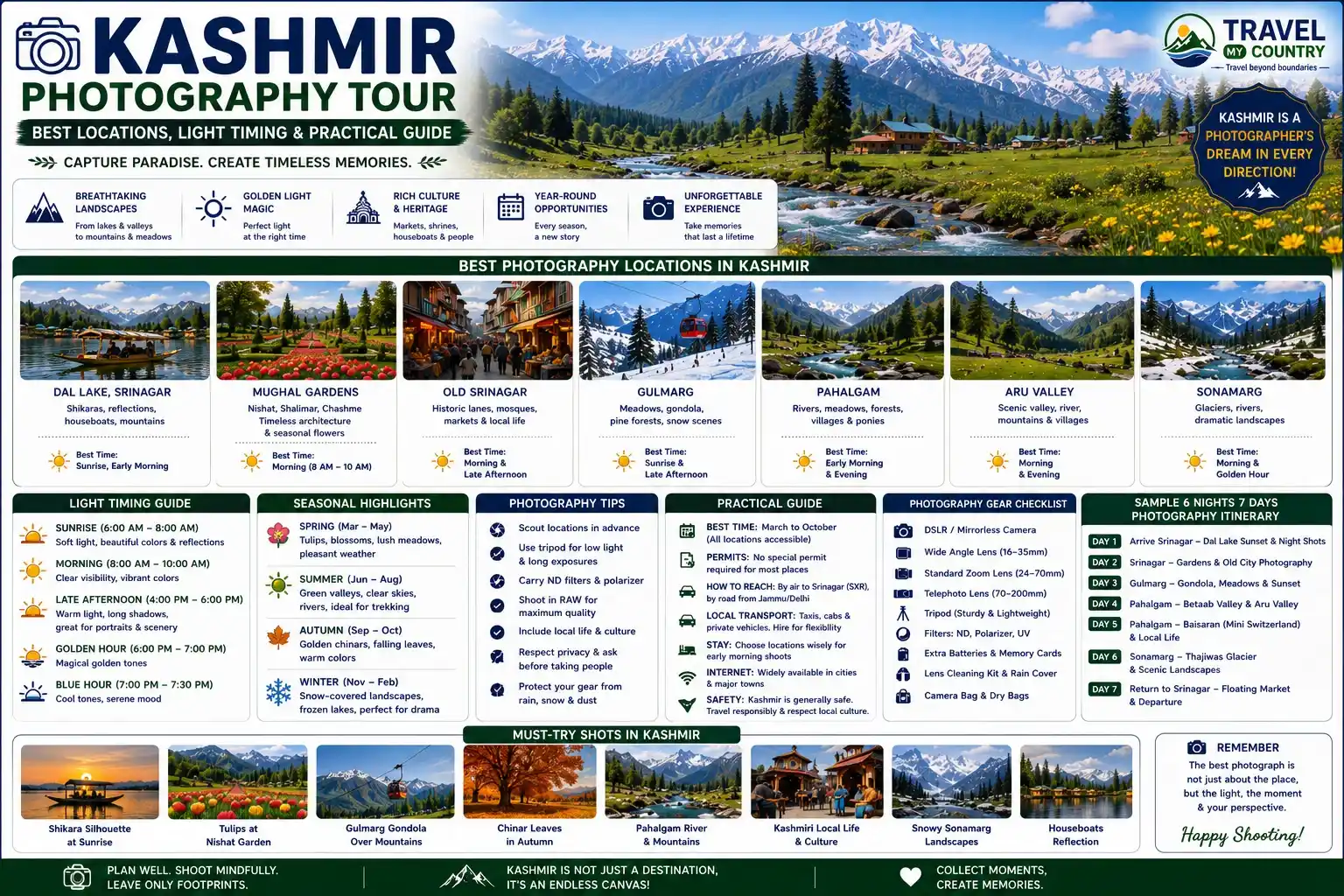
Kashmir is one of the most photographically rich destinations in Asia — a combination of dramatic mountain landscapes, living craft traditions, water-based daily life on Dal Lake, and an architectural heritage that ranges from Mughal garden design to centuries-old wooden mosques. The challenge is not finding subjects to photograph; it is having the local knowledge to be in the right place at the right time with the right access. This guide covers the best photography locations, the critical light windows, and the practical considerations for making a Kashmir photography trip genuinely productive.
Dal Lake — Floating Market at Dawn
The floating vegetable market on Dal Lake (specifically the channel east of Nehru Park, near the wholesale shikara market area) operates from approximately 05:30 to 08:00. Farmers arrive by shikara from their vegetable gardens on the lake’s floating islands, wholesale buyers arrive in their own shikaras, and transactions happen boat-to-boat on the water. The light in June–September in this window is extraordinary — low-angle golden hour light raking across the lake surface, mist rising off the water, reflections in the still channels. This is among the finest documentary photography situations in India. We arrange private shikara access to this area for our photography guests — entering on a tourist shikara during active trading is possible but requires a guide who has a relationship with the market traders. Without this, photographers are kept at the perimeter.
Thiksey Monastery (Ladakh) — Morning Puja
For combined Kashmir + Ladakh photography trips: Thiksey Monastery near Leh holds a morning puja (prayer ceremony) at 06:00–07:30. The monks assemble in the main prayer hall lit by butter lamps and shafts of natural light entering through high windows. The combination of monk robes (deep maroon, orange), the flickering lamp light, the chanting, and the architecture produces images of extraordinary quality. Access requires being present at the monastery at 06:00 — which means either staying in a nearby guesthouse or departing Leh at 05:30. We coordinate this for all our Ladakh photography guests. Photographing respectfully (no flash, stay at the back of the hall, do not disrupt the ceremony) is essential — the monastery allows photography but respect must be explicit.
Nishat Bagh & Shalimar Bagh — Mughal Garden Symmetry
The Mughal gardens of Srinagar — Nishat, Shalimar, and Chashme Shahi — are formal gardens built on terraces rising from Dal Lake, with the Zabarwan range as backdrop. They are best photographed in two windows: early morning (07:00–09:00, before tour buses arrive) and late afternoon (16:00–18:00, when the light warms and the mountains take on colour). The June bloom is the most spectacular for flower photography — irises, roses, and mixed seasonal beds in full colour. October chinar trees turning gold provide an entirely different palette. We book our photography guests into the gardens at opening time — the difference between a 7am visit with almost no one there and a 10am visit with tour groups is dramatic for composition.
Pahalgam and Betaab Valley — Mountain Meadow Compositions
Betaab Valley (10 km from Pahalgam) is a wide river meadow framed by pine forests and the Lidder River. The landscape is immediately cinematic — it has been used as a film location repeatedly, hence the name (from a 1983 Bollywood film). Morning light on the pine slopes produces rich golden-green tones. The Lidder River in late spring carries snowmelt and runs fast and clear — long-exposure river photography here is particularly effective. Baisaran meadow (accessible by horse or a 3 km walk from Pahalgam) provides open alpine meadow with 360-degree mountain views and far fewer visitors than Betaab. The late afternoon light at Baisaran in September, when the meadow grass is starting to yellow, is among the finest landscape photography situations in the valley.
Gulmarg — High-Altitude Snow Landscape
Gulmarg’s Gondola takes photographers to Phase 2 at 3,980 m — above the treeline, in open snowfields with unobstructed views of the Pir Panjal range and Apharwat Peak (4,390 m). The quality of light at altitude (thinner atmosphere, no haze) produces cleaner, more saturated images than valley-level shooting. In winter (December–February), Gulmarg’s ski runs and snow-covered meadow provide exceptional snowscape photography. Timing: first gondola (08:30–09:00) for clearest light and fewest people at the Phase 2 station. The walk from Phase 2 gondola station across to the Apharwat ridge (1.5 km on snow, requires trekking poles in winter) opens up the widest mountain panoramas.
Pangong Lake (Ladakh) — Dawn Colour Sequence
For combined Kashmir + Ladakh photography trips: Pangong Lake at 4,350 m is one of the most-photographed locations in Asia, and for good reason — the 14 km visible stretch of the lake changes colour as light conditions change (deep black pre-dawn, purple and violet in first light, electric blue in full sun, silver-grey at dusk). The dawn colour sequence lasts approximately 45 minutes and is the peak photography window. Being at the lake’s edge at 05:00 is essential — which requires overnight camping at the lake or the early departures from campsites 4 km away. We arrange this timing precisely for our photography guests. The south bank (less accessible than the north) offers reflections of the barren Tibetan-plateau landscape in the lake surface — the composition possibilities differ entirely from the north bank tourist zone.
Photography-Specific Logistics
Equipment transport: Camera bodies, lenses, and tripods can all be carried in flight hold luggage to Srinagar (SXR) and Leh (IXL). Lithium batteries have airline restrictions (carry-on only for batteries above 100Wh) — check specific airline policy. Dust in Ladakh: The high-altitude desert environment at Nubra and Pangong is extremely dusty — bring a blower brush and sensor cleaning kit. Lens changes should be done inside a vehicle. Cold at altitude: Battery performance degrades significantly below 5°C — carry 2–3 spare batteries and keep them warm in an inner pocket. Drone photography: Drone use in J&K requires prior permission from the Civil Aviation Authority and local district authorities. The process is complex and we strongly advise against attempting unauthorised drone flights — penalties are significant and military airspace concerns are real in this region. We advise all photography guests on current drone regulations before travel.
We build itineraries around light windows, arrange early market access, and time monastery visits for puja hours. Our drivers know which dirt tracks reach viewpoints that aren’t on maps. Photography trips are among our most satisfying work.
Plan Your Kashmir Photography Trip →
Frequently Asked Questions
What is the best month for photography in Kashmir?
October for variety and colour — golden chinar trees, clear post-monsoon skies, and thinner crowds giving cleaner compositions at key locations. June for wildflower meadows and green valley. March–April for almond and cherry blossom in the Kashmir valley (particularly around Badami Bagh and the village orchards of Shopian). Each month offers something distinct — we can advise on the optimal window for your specific photographic interests.
Do I need a guide for photography in Kashmir?
Not strictly necessary for the standard locations (Mughal gardens, Gulmarg, Pahalgam). For the Dal Lake floating market at dawn, Gurez Valley, or Ladakh monastery access, a local guide with existing relationships makes a significant difference — both in terms of access and in terms of not being treated as a tourist intrusion in working and religious spaces. Our photography guests consistently report that having a local with them opened doors that they could not have accessed independently.
Can I photograph inside Kashmiri mosques and shrines?
The Hazratbal Shrine and Jamia Masjid in Srinagar do not generally permit interior photography. Exterior photography is fine. Some smaller dargahs (Sufi shrines) are more permissive but require asking permission from the caretaker (khadim). We brief all photography guests on specific protocols for religious sites. The general rule: always ask before raising a camera in a religious or domestic space.