
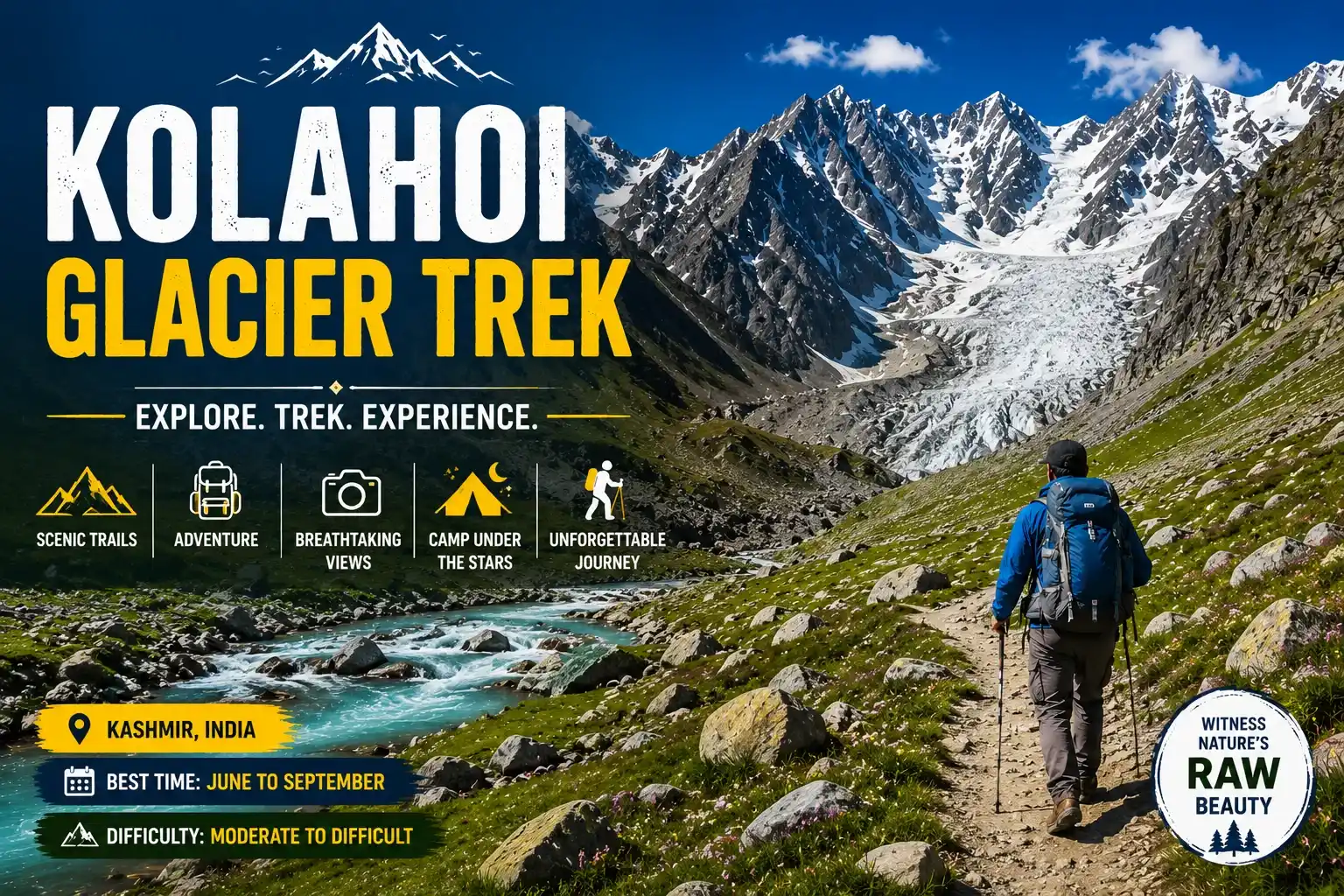
The Kolahoi Glacier trek takes you to the largest glacier in the Kashmir Valley — the source of the Lidder River, sitting at the foot of the Kolahoi Peak (5,425 m), which Kashmiri mythology calls the “Goddess of Light.” The trek begins from Pahalgam, passes through the beautiful Aru Valley, crosses the meadow camps of Lidderwat and Satlanjan, and ends at the glacier base where meltwater pours from ancient ice walls into the valley below. It is a 6-day trek of moderate difficulty, and it is one of the most complete wilderness experiences Kashmir has to offer — river valleys, alpine meadows, glacier ice, and dramatic Himalayan peaks in a single route.
Kolahoi Glacier Trek Overview
- Duration: 6 Days / 5 Nights
- Starting/ending point: Aru Village, Pahalgam (96 km from Srinagar)
- Maximum altitude: ~3,800 metres (Kolahoi Glacier base)
- Difficulty: Moderate — longer duration but no technical sections
- Best season: June to September
- Price: ₹15,500 per person (all-inclusive)
Day-by-Day Itinerary
Day 1 — Srinagar to Aru Village (Drive + Acclimatisation)
Drive from Srinagar to Aru Village (~3 hours via Pahalgam). Aru sits at 2,414 metres in a broad meadow where the Lidder River runs shallow and cold. The afternoon is for gear check, guide briefing, and acclimatisation — walking slowly around the meadow while your body adjusts to the altitude. Overnight at Aru camp.
Day 2 — Aru to Lidderwat (Trek: ~11 km, 5–6 hours)
The trail follows the Lidder River upstream through forests of pine, fir, and Himalayan birch. The ascent is gradual — this is one of the most pleasant walking days of the whole route. Lidderwat, at 3,050 metres, is an open meadow where the Lidder splits into two tributaries. The campsite here has sweeping views and is often shared with shepherd families who use the high pastures in summer. Overnight at Lidderwat.
Day 3 — Lidderwat to Satlanjan (Trek: ~9 km, 4–5 hours)
A shorter day that climbs steadily from the Lidderwat meadow to Satlanjan at 3,400 metres. The vegetation here is sparse — low alpine plants, lichen-covered rocks, and occasional patches of snow even in July. The peak of Kolahoi comes into view properly for the first time from Satlanjan — a massive, glaciated pyramid that fills the upper valley. The campsite sits in a moraine field with excellent views of the peak and the glacier above. Overnight at Satlanjan.
Day 4 — Satlanjan to Kolahoi Glacier Base and back (Trek: ~10 km, 6–7 hours)
The crux day. The trail crosses moraines and boulder fields to reach the Kolahoi Glacier snout at approximately 3,800 metres. The glacier is a living thing — you can hear it creak and groan as the ice shifts, and the meltwater streams that pour from its base run milky white with glacial flour. This is as close as most trekkers get to standing at the foot of a major Himalayan glacier without technical climbing skills. The views of Kolahoi Peak directly above are extraordinary. Return to Satlanjan by late afternoon. Overnight at Satlanjan.
Day 5 — Satlanjan to Lidderwat (Trek: ~9 km, 4 hours)
An easy descent back to Lidderwat, retracing Day 3’s route. The downward direction gives a completely different perspective on the valley. Final night at Lidderwat.
Day 6 — Lidderwat to Aru Village (Trek: ~11 km, 4–5 hours) + Drive to Srinagar
The final descent to Aru follows the river back through the forest. Arrival at Aru by midday, drive back to Srinagar by evening.
What is Included in the ₹15,500 Package
- Return transport Srinagar to Aru and back
- Certified Kashmiri trek guide with Wilderness First Aid certification
- All meals on trail (breakfast, packed lunch, dinner) — 5 nights
- Camping equipment (double-layer tents, sleeping mats, kitchen shelter)
- Horsemen and pack horses to carry all camp equipment
- Forest and trek permits
About Kolahoi Peak — The Goddess of Light
Kolahoi (5,425 m) is the highest peak entirely within the Kashmir Valley and one of the most significant mountains in Kashmiri cultural memory. The name translates roughly as “Goddess of Light” — in local mythology, the mountain is a female deity whose icy summit catches the first and last light of each day. The peak was first climbed in 1912 by British explorer Ernest Neve and has been a prized mountaineering objective ever since. For trekkers on the glacier approach, the summit is not accessible (it requires ice climbing equipment and experience), but the glacier base offers a view of the full mountain face that few people ever see.
Frequently Asked Questions — Kolahoi Glacier Trek
How does Kolahoi compare to the Tarsar Marsar trek?
Kolahoi is longer (6 days vs 5 days) and the maximum altitude is similar (~3,800m). Tarsar Marsar involves more altitude gain in a single day (the Marsar crossing). Kolahoi’s route is more sustained and culminates at a glacier — a different kind of dramatic endpoint. Both are classified as moderate. If you have done one, the other is very accessible.
Can I see the glacier even if it’s partially melted in late summer?
Yes. The Kolahoi Glacier’s upper section and snout (where meltwater streams emerge from under the ice) are visible and impressive throughout the trekking season. The best time for the most photogenic glacier view is June and early July, when snowfall from the previous winter still covers the approach moraines.
Is this trek suitable for solo travellers?
Yes — our fixed-departure weekend batches include solo trekkers regularly. You will be placed in a small group (typically 4–8 people) with a shared guide and camp team. Private departures for individuals or couples are available on request at a slightly higher price.
To book or enquire, WhatsApp us at +91 700 66 88 931. We run this route from June through September. See also our Great Lakes of Kashmir trek or browse all Kashmir trekking options.