
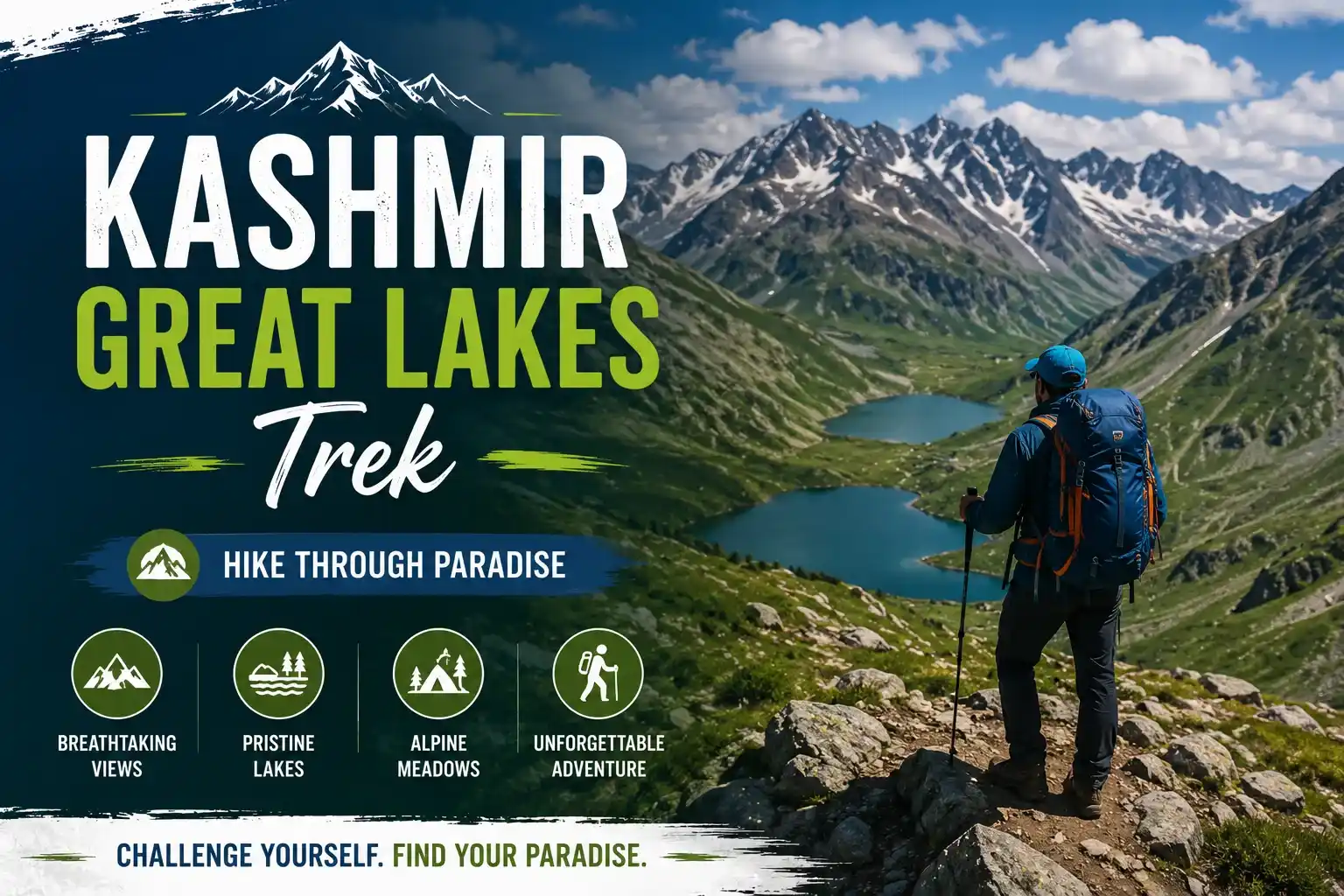
Travel My Country · Fixed departures 15 July – 25 August 2026 · max 12 trekkers/batch · Kashmiri guide + cook + mules · Wilderness First Aid certified · +91 70066 88931
Our August 2025 batch saw the only 4 sunny days that month — and the reason is simple: we shift our departures based on the Kashmir Met office forecast, not a printed brochure. The Great Lakes trek is the most beautiful thing you can do on foot in India. It is also weather-sensitive in ways national operators don’t always respect. My cousin Tanvir leads our trek. He’s from Naranag village (where the trek ends), and he’s walked this route 41 times.
What makes the Great Lakes trek a once-in-a-lifetime route
You cross five high passes and walk past seven alpine lakes in seven days. Maximum altitude 4,150 m (13,615 ft) at Gadsar Pass. The lakes are still unspoiled — no rest houses, no commercial campsites, only the meadows. The Pir Panjal and the Greater Himalaya frame every direction. Start: Sonamarg (2,800 m). End: Naranag (2,300 m). Total walking distance: 72 km.
Day-by-day 7D/6N itinerary
Day 1 — Srinagar to Sonamarg (2,800 m), drive 87 km
We pick you up at SXR or your Srinagar hotel at 7 AM. 3-hour drive to Sonamarg through Ganderbal and Kangan. Briefing, gear check, dinner. Sleep at Shitkadi camp near Sonamarg.
Day 2 — Shitkadi to Nichnai (3,500 m), walk 12 km / 6 hr
Gradual climb through pine forest, then alpine meadow. First view of Nichnai meadow at lunch. Camp at the meadow edge near a small glacial stream.
Day 3 — Nichnai to Vishansar Lake (3,710 m) via Nichnai Pass (4,100 m), walk 13 km / 7 hr
The first real test. Climb to Nichnai Pass. Descent to Vishansar Lake — the most photographed lake on the trek. Camp on the meadow above the lake.
Day 4 — Vishansar to Gadsar (3,600 m) via Gadsar Pass (4,150 m), walk 14 km / 8 hr
The hardest day. Pass two lakes — Vishansar and Krishansar — climb to Gadsar Pass with stunning views of both. Descent to Gadsar Lake. Army registration at Gadsar (carry your ID).
Day 5 — Gadsar to Satsar (3,600 m), walk 11 km / 6 hr
Easier day. Walk past Yamhar Pass and into the Satsar bowl — seven small lakes connected by streams. Camp by the lower lakes.
Day 6 — Satsar to Gangbal Twin Lakes (3,575 m) via Zaj Pass (4,080 m), walk 12 km / 8 hr
Climb Zaj Pass, drop into the Gangbal valley. Twin lakes Gangbal and Nundkol below the holy Mount Haramukh (5,142 m). Final high camp.
Day 7 — Gangbal to Naranag (2,300 m), walk 10 km / 5 hr — drive to Srinagar
Steep descent through pine forest to the Naranag temple complex (8th-century ruins). Lunch in Naranag. Drive to Srinagar (90 km, 3 hours).
Difficulty, max altitude, fitness
- Grade: Moderate-Difficult
- Max altitude: 4,150 m (Gadsar Pass)
- Total walking: 72 km over 6 days
- Daily walking: 10–14 km, 5–8 hours
- Fitness target: 5 km in 30 minutes on flat ground, 3 weeks before departure
Fixed-departure calendar 2026
- 15 July – 21 July (8 slots open)
- 22 July – 28 July (full)
- 29 July – 4 August (8 slots open)
- 5 August – 11 August (10 slots open)
- 12 August – 18 August (12 slots open)
- 19 August – 25 August (last batch — 4 slots)
What’s included (₹16,900 per person)
- All meals from Day 1 dinner to Day 7 lunch (vegetarian, hot fresh food)
- Tents (twin-share), sleeping bags rated to −5°C, mattresses
- Certified Kashmiri trek leader + Wilderness First Aid kit + oximeter
- Cook + helpers + mules for kitchen and common gear
- Forest permits, army registration
- Srinagar to Sonamarg + Naranag to Srinagar transfers
What’s not included
- Personal trek gear (boots, jackets, rucksack)
- Mule for personal bag offload — ₹3,500 for the full trek (book ahead)
- Travel insurance (mandatory — Asego or Tata AIG recommended)
Frequently Asked Questions
How fit do I need to be for the Great Lakes trek?
Cardio: be able to jog 5 km in 30 minutes 3 weeks before. Stairs: climb 8 flights without stopping. We also do a 30-minute fitness assessment at base camp before Day 2 — if anyone isn’t ready, we don’t let them up.
What is the max altitude and AMS risk?
4,150 m at Gadsar Pass. Moderate AMS risk. We acclimatise across 2 nights at 3,500+ m before crossing the pass. We carry Diamox and portable oxygen. Headaches on Day 3 are normal; vomiting or confusion = immediate descent.
Can a 50-year-old do this trek?
Yes — about 20% of our trekkers are 45+. Fitness matters more than age. We’ve had a 64-year-old finish the route in 2024.
Are leeches a problem on this trek?
Only in the first half of July on the descent forest into Naranag, and only after rain. Wear gaiters or long socks; carry salt.
What if it rains for multiple days?
We have a 24-hour buffer day at Vishansar. Beyond that, we descend; we don’t push trekkers through whiteout conditions. If a batch is cancelled mid-trek due to weather, you get a 40% refund or full credit for a future batch.
Is the trek possible solo (without a group)?
Yes — you can join a fixed-departure batch as a single. Twin-share tent with another solo trekker of the same gender. Single tent supplement ₹2,800 extra.
Reserve your slot
WhatsApp +91 70066 88931 with your preferred batch dates. 20% advance to confirm. Download our gear checklist after booking.
See also: Tarsar Marsar trek · Bangus Valley trek · Best time to visit · Cab to Sonamarg / from Naranag